One of the first officially documented brides in white was the Brit Anna, who married Louie XII in 1499. Margaret Tudor, daughter of Henry VII married four years later in white jacquard dress, edged with crimson – a traditional for the royal court.
Antiquity – Rituals
In ancient Egypt, brides traditionally were covered with layers of white linen. In Greece, the white color is taken as a celebration – the reason brides can wear on her wedding.
In Rome, brides wore a finely pleated white robes as a homage to the god of fertility and marriage – Hymen. It was believed that he liked this particular color
What look something like striking visual contrast was that Greek and Roman brides cover their heads with a fiery red veil as a sign of modesty.
1500-1600 years – Royal Tradition
One of the first officially recorded brides in white was British Anna, who married Louis XII in 1499.Margaret Tudor, daughter of Henry VII married four years later in a white jacquard dress, edged with purple – traditional royal color.
In 1612 when Princess Elizabeth, daughter of King James I, married, wore a silver dress, all embroidered with pearls, silver and gems.In those days, оnly royals and aristocrats could afford the luxury of specially designed wedding dress.
Оrdinary people, including those from the American colonies, the day of the wedding dress just the most beautiful new clothes.
If they sewing a new dress, they chose fabrics in pastel blue, gray and brown scales, which are then easily able to get into their everyday wardrobe. Only the green color was not desired- was assumed that brings unhappiness.
1800 – Lux
Most brides of royal lineage adhered to luxurious fabrics in silver and red. Ordinary girls wore elegant dresses in muted colors with floral patterns.
On February 11 1840 Queen Victoriа appeared on her wedding in all white ensemble. Her rich satin dress is adorned with orange flowers and a 6 m loop that held thrown over her hand. Wore on his head a crown of flowers intertwined with diamonds and lace veil.
Awarded for its grace and beauty, she became responsible for the establishment of a white dress as an ideal for the wedding day in the West.
The resulting boom was helped by growing wealth and the creation of middle and upper middle class. Representatives of these classes could afford such luxury.
During this period, American women continued to lead the English and French Fashion. Especially their influence exerted Charles Frederick Worth – the most powerful of its time designer who created in London and Paris.
In the middle of the century, during the Civil War, brides were limited to the ability to wear the most beautiful dress she had.
Postwar industrialization put a new era of prosperity – again brides enjoyed a rich theatrical decoration and train the current day dress with a bustle.
 1900 – Courtesies
In the early twentieth century, brides still felt the weight of moral and genteel Victorian style, which requires white dresses with long sleeves, air to ground veils and chokers. During this period, manufacturers of clothing for the first time produced wear bridal gowns for busy growing middle class.
Changes occurred in 1914 when World War I started. Corsets with outmoded structure to give way to more free silhouettes. Women say goodbye to construct clothing from the past.
20s – Innovation
The changes that started in social terms even during the First World War finally turned the status of women.America, for example, led the fight against fulfilling their traditional role “Nineteenth Amendment” gave women the right to vote. Then the Americans celebrated their freedom, she cut her hair in flirtatious style wearing shorter and more free dresses.Happy, they abandoned them restricting corsets. Ladies of high society still turned to Paris for their clothes and just at this time Jean and Coco Chanel Lanven risen sharply.
Ms. Chanel introduced the first official short knee wedding dress. Although made of traditional wedding robe fabric, it is complemented by a rich royal veil and train. Become the most popular model, introducing fashion “girl woman.”
30s – Lustrous sophistication
Frivolity of the period “woman-girl” prepare the way of the Great Depression in America in the ’30s. Dark and difficult times affect the severity of the new wedding gown. Ornate long knee models with expensive decorations were replaced by soft, clean and cut a silk bias to the ground.
People found shelter in film fantasies spewing from booming Hollywood stars, whose influence grew with revitalizing to the end of the decade economy.
As a result, American designers have become celebrities and started to create a sleek and modern dresses that mimic the glamor and romance of the film.
Remarkably the end of the period was the introduction of synthetic fabrics. In the 1938th they were taken from both designers and consumers because of their low cost and versatility.
Leaving depression behind his back, brides have no restrictions. Does a wedding dress that they used as required lace, brocade and silk.
40s – Refined Style
Just when things started to revive after the Depression, World War II came. Men and women went to the front. . Produce unnecessary stuff was suspended and strict supplies become status quo.
Limitations inevitably affect the style and Bridal Gowns. Imports of textiles were limited and the lack of any type of fabrics led to innovative selection of wedding dress.
Married brides dressed in their finest costumes or just in everyday clothes.
Weddings, of course, were preceded by betrothal. However, the time between two events lasted only a few days or weeks before their husbands to go abroad fighting flank. Anyway, not much time for planning wedding dress.
In this period appeared an alternative. Taking a traditional white dress from friends or just rent.
50s- Symbolic elegance
The postwar years were a time of festivity and prosperity. In essence, the traditional dress type “Cinderella”, created in the XIX century, reborn and wedding dresses started to become more lavish than ever.
Waist were very small-holding puffed skirts cocktail length.
Nylon became a postwar phenomenon and fashion designers started creating crinolines, bridal veils and hard nylon fabric network.
Married brides are often raised in white dresses with no train, made from actual lace crinoline fabric on hard, solid molded tops and waist highlighted. On their heads was placed fallen short veil.
Among the most influential designers of the decade were Balenciaga and Givenchy.
They contributed to the whiff of refinement and good taste prevailed during this period.
60s- Official freedom
Throughout most of the 60s prevailed official wedding gowns. The most popular models were the longer versions of the frilly skirt tight bustier, which are liked in the 50s.
At the end of the decade, young couples started to rebel, avoiding long standing wedding traditions of their parents’ generation in favor of simpler ceremonies and freedom of expression. Many brides say “goodbye” of tulle and lace.
Instead, they chose cotton caftans and shirts style “smock” to say “Yes.” Corresponding to the short-lived fashion clothing disposable in 1967 saw even wedding dresses made of paper.
70s – Sexy Simplicity
During most of the last decade have expressive style. Recently freed women definitely broken with modest traditions of the past. For the first time they were able to choose what type of bride to be.
70s seen it all – from traditional wills and lace up mini skirts and trousers. Modern Bride of time to the extent accepted their sexuality that white suit with an open, revealing jacket thought of something.
80s – Fairy tale
In 1981, when Lady Di married Prince Charles, reminded the world how romantic it would be Bridal Gowns. The princess looked radiant in a gown of taffeta, decorated with thousands of sequins and beads, antique lace and a huge 7 meters above the train
Suddenly, legions of brides wish dresses suitable for royalty and ending with train. Their mandatory veils were decorated with stones. Not surprisingly, the big white dress back in fashion, in style, avenging “the more layers and decorations, the better.”
The scene came out Vera Wang prom dresses which depicted the princess bride.
90s- Ordinary Beauty
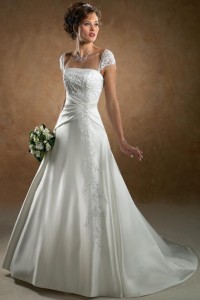 While 90-year tumble, extravagance and vanity displays of wealth, for the 80 characteristics they gradually lost popularity. This happens ornate wedding dress. Instead this image models of the decade, characterized by sensuous and uncomplicated form and style.
Enter A-line and tailored lines. Popular becoming shorter dresses screams of colors pantsuit. Not to mention the dress-suit, which became a hit for one day after Karnolin Bisset wears to marry John F. Kennedy Jr.
More than ever, the bride can choose a dress that reflects her unique personality.
Today – Mixing old and new
Part of the new millennium bridal fashion can be described as a fascinating mixture of old and new, of classic design and bold detail.
There really is something for everyone – be it moving body bare back dress with a scandalous woman in sheer dress A-line transparent layers, asymmetrical ensemble of minimalist or bold strapless bustier with frilly tulle skirt perfect princess .
With a whiff of freshness and amusing eccentric attend a dress decorated with splashes of color.
The fabrics are embellished with everything – from pink, blue, platinum embroidery in shiny crystals in the shape of a teardrop, lace trim, soft feathers and down.
The choice is endless.
While some forms of today are far from the dresses that are worn in the late XIX century, it has some other tradition. How? While dressed in white, you contribute to the maintenance of custom.